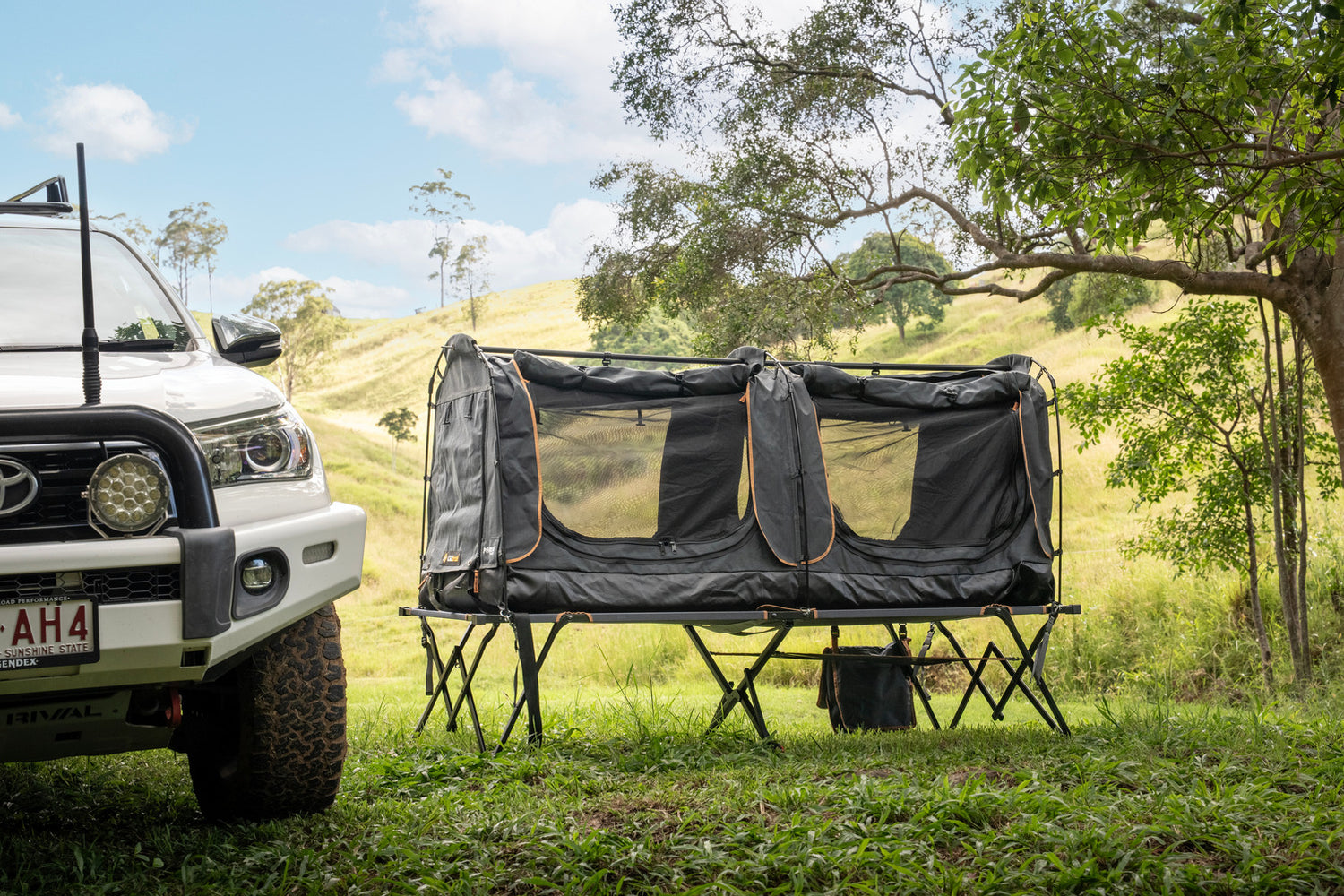
The Expert Guide to Swag Camping

And Choosing Your Best Shelter

There’s a reason swag camping has been part of the Australian outdoor tradition for over a century. From quick weekend escapes to extended outback trips, swags have earned their place as an Aussie camping essential thanks to their simplicity, durability, and comfort.

But for all their simplicity, choosing the right swag and setting it up properly is where many new campers go wrong. This guide covers everything you need to know: what a swag actually is, how to pick one, how to care for it, and which setup works best for your style of travel, whether you're loading up a ute tray for a week in the outback or packing light for a motorcycle tour.

What Is a Swag? The Australian Camping Icon Explained 

A swag is a self-contained bedroll with canvas on the outside and a mattress inside. You roll it out, unzip the top, and you're ready for the night.  

Traditionally associated with stockmen and drovers who needed a carry-all sleep system for long stretches in the bush, the modern swag has evolved significantly. Today's swags feature water-resistant or waterproof canvas, foam mattresses ranging from 50mm to 100mm, and built-in hoops or poles that lift the canvas off your face so you can actually breathe and sleep comfortably. 

The canvas construction is what sets a swag apart. Unlike a nylon tent, canvas breathes, which means condensation management is far better in temperature extremes. Canvas also holds warmth more effectively at night and resists radiant heat during the day. In the Australian outback, where temperatures can swing 20°C between midday and midnight, that matters more than most campers realise. 

One thing to understand before you buy: a swag is not a tent. It's not designed for extended wet weather camping or for campsites where you need to be off the ground. What it is designed for, and what it does brilliantly, is getting you outside, close to the ground, in the Australian wilderness, with as little faff as possible. 

If you're still figuring out which style suits you, swag camping is a broader topic than most people expect, and the differences between styles are worth understanding before you buy. 

How to Choose the Best Swag Camping Setup for Your Trip 

Your best swag camping setup comes down to three questions: how you're travelling, how many people you're sleeping with, and what conditions you'll face.

  • How you're getting there

    Determines weight and pack size. If you have a ute tray or a 4WD with a roof rack, a large double-hoop swag with a 10cm foam mattress is completely manageable. If you're on a motorcycle or hiking to a campsite, every kilogram counts and a compact bivy is the smarter call.

    01

  • Who you're sleeping with 

    Is straightforward but often overlooked. A single swag for one person is cosy. A single swag for two is miserable. If you're camping as a couple, a double swag built for two is the answer, and it's worth doing properly rather than suffering through a cramped night.

    02

  • What conditions you'll face

    Shapes your canvas weight, mattress thickness, and whether you need a full hooped dome or a simpler lay-flat design. Hot, dry outback conditions suit lighter canvas and open-top sleeping. Cold nights need a warmer sleeping bag inside and a swag with sealed seams.

    03

1 of 3

Matching Your Swag to the Australian Outback

The outback is the environment swags were designed for. Long, sunny days and cold, clear nights with minimal rain mean canvas durability and ground insulation matter more than waterproofing. A mid-weight canvas swag with a good foam mattress will handle outback conditions comfortably, and you'll want to sleep with the cover unzipped or fully peeled back to watch the night sky above you, one of those simple pleasures that makes the whole trip worthwhile.

If you want fabric specs, hoop designs, and top picks by budget, the best swags for camping covers all of that in detail.

Compare Single Swags

Swipe to Compare Swags

  • Mitchell 900

    Mitchell 900

    Key Features

    • Freestanding
    • Best value
    • 5-7cm comfort mattress

    Best For

    • First time buyers
    • Weekend/Outback runs
    Shop Now
  • Sundowner 900

    Sundowner 900

    Key Features

    • Lumos LED
    • Climatech vents
    • 6-panel internal storage
    • 600 GSM floor

    Best For

    • Premium touring
    • Longer trips
    Shop Now
  • Cooper Expedition

    Cooper Expedition

    Key Features

    • No poles
    • Small and light (4.5kg)
    • Simple setup

    Best For

    • Hunting and fishing
    • Quick overnighters
    Shop Now
  • Biker Expedition

    Biker Expedition

    Key Features

    • Sit-up headroom
    • Straps to bike
    • Compact structured shelter

    Best For

    • Motorcycle touring
    Shop Now
Swag Image Series Key Features Best For View Product
Mitchell 900
Mitchell 900
  • Freestanding
  • Best value
  • 5-7cm comfort mattress
  • First time buyers
  • Weekend/Outback runs
Shop Now
Sundowner 900
Sundowner 900
  • Lumos LED
  • Climatech vents
  • 6-panel internal storage
  • 600 GSM floor
  • Premium touring
  • Longer trips
Shop Now
Cooper Expedition
Cooper Expedition
  • No poles
  • Small and light (4.5kg)
  • Simple setup
  • Hunting and fishing
  • Quick overnighters
Shop Now
Biker Expedition
Biker Expedition
  • Sit-up headroom
  • Straps to bike
  • Compact structured shelter
  • Motorcycle touring
Shop Now

Swags vs Tents: Which Shelter Belongs on Your Camping Trip?

This is the question every new camper asks, and the answer isn't as obvious as it seems. Swags and tents are genuinely different tools for different camping styles, and neither is universally better. 

A tent gives you a freestanding structure with more headroom, better separation from insects and rain, and the ability to stand up, store gear inside, and manage extended wet weather. A swag gives you simplicity, durability, fast setup (two minutes versus ten), and a sleeping experience that's much closer to actually being outdoors. 

For Australian summer camping in the outback or along the coast, a swag typically wins on comfort and convenience. For extended trips through tropical Queensland during wet season, or winter camping in the mountains, a tent offers more weather protection. 

The honest answer for most Australian campers: a swag is the better choice nine months of the year. A tent earns its place in the shoulder season and when families need the extra room. 

For most Australian campers, swags vs tents comes down to the season and how much weather protection you actually need.

Seasoning Your Swag: How to Waterproof Canvas Before Your First Trip 

This is the step most first-time swag owners skip, and they pay for it the first time it rains. The canvas itself comes with a waterproof coating, so water will bead off the surface straight away. The vulnerable points are the seams: wherever the canvas is stitched, the needle holes need to swell shut before the swag is genuinely watertight. That's what seasoning does. Skip it and you'll wake up to water wicking through the stitching and a damp sleeping bag.

Seasoning works by wetting the canvas so the fibres around every seam swell and close the tiny holes left by the stitching needle. It's not complicated, but it does need to be done properly.

  • Step 1

    Set your new swag up in the backyard or on the driveway, somewhere you can soak it thoroughly

    01

  • Step 2

    Wet the entire canvas with a garden hose, paying close attention to seams and stitching

    02

  • Step 3

    Allow it to dry completely in the sun, which can take several hours

    03

  • Step 4

    Repeat the wet-and-dry cycle two to three times so the seams swell and seal fully

    04

1 of 4

The seams deserve special attention. Where canvas is stitched, needle holes create the most vulnerable points for water entry. A seam sealer applied after the initial seasoning rounds provides significantly better protection in heavy rain.

If you want the full step-by-step on how to season a swag, including which sealants work best and how to bring an older swag back to life, that's covered in detail there.

Swag Camping for Couples: Double Swags and What to Look For

Sleeping in a single swag with another person is one of the fastest ways to have a disagreement at a campsite. There's not enough room, the mattress inside a standard single won't accommodate two adults comfortably, and whoever's on the outside edge will spend the night rolling back in.

A genuine double swag fixes all of this. Built wider and longer than a single, with a thicker foam mattress and a larger canvas shell, a quality double swag is genuinely comfortable for two, not just technically big enough.

What to look for in a double swag:

  • Internal width of at least 140cm; anything narrower and you'll feel it by 3am 
  • Mattress thickness of 75mm or more; the extra foam matters significantly when two people are compressing it 
  • Dual hoops or a dome frame to lift the canvas clear of both sleepers' faces 
  • Separate sleeping bag compatibility if one partner runs hotter than the other 

Double swags are heavier and bulkier than singles, which makes them better suited to vehicle-based camping than walk-in or motorcycle trips. But for couples doing weekend camping trips and outback adventures, the comfort difference versus two singles or a cramped tent is substantial.

If you're still weighing up double and single swags, the sizing guides and warmth ratings there make the decision straightforward.

Best Swag for Motorcycle Touring and Lightweight Travel

The weight constraints of motorcycle touring change every gear decision, and swag selection is no exception. The wrong swag on a motorbike tour isn't just inconvenient. A heavy, bulky bedroll strapped to a rack affects handling, adds fuel consumption, and makes you miserable every time you pack up camp.

The ideal motorcycle swag is compact when rolled, light enough to strap to a rack or pack into panniers, and still functional enough to keep you warm and dry. That usually means:

  • Single-hoop or no-hoop design so the swag packs down significantly smaller than a dome-frame model
  • Lighter canvas weight around 10oz, which is meaningfully lighter than 16oz for minimal trade-off in moderate conditions
  • Built-in sleeping bag rated to 5-10°C, enough for most Australian nights without needing to carry a separate bag
  • Packed dimensions under 60cm, as anything longer becomes awkward to strap cleanly to a motorcycle rack

The trade-off with a lightweight swag is durability and weather resistance. A lighter canvas swag won't outlast a heavier-duty model, and in sustained rain you'll feel it. For fair-weather motorcycle touring in Australia, which describes most of the calendar year across most of the country, that's an acceptable trade.

If the best swag for motorcycle touring is what you're after, pack sizes, weights, and top picks by category are all covered there.

Caring for Your Swag: Storage, Cleaning, and Making It Last

A quality canvas swag is an investment, and with the right care, it should last a decade or more. Most swag damage comes not from use but from poor storage and maintenance between trips.

  • Air the swag completely

    Air dry completely before rolling it up. Canvas stored damp will mildew, and once mildew sets into canvas fibres it's difficult to remove and permanently weakens the material

    01

  • Brush It Down

    Brush off any dirt, grass, or debris from the canvas exterior

    02

  • Check the seams

    Check seams and stitching for wear after every trip, particularly along the base and around zipper attachments.

    03

1 of 3
  • Roll it loosely

    Store rolled loosely, not compressed tightly. Long-term compression reduces the foam mattress's ability to recover its shape.

    01

  • Store it smart

    Keep in a cool, dry location away from direct sunlight, which degrades the canvas UV resistance over time.

    02

  • Let it breathe

    Avoid plastic storage bags that trap moisture. A breathable cotton bag or simple open shelf is the better option.

    03

1 of 3

Re-seasoning

Canvas loses water resistance over time with UV exposure and use. If you notice water soaking in rather than beading, it's time to re-season. This is the same wet-and-dry cycle used for initial seasoning, and two or three rounds will restore the canvas's water resistance for another season.

A swag that's properly cared for doesn't just last longer. It performs better every trip. The canvas stays supple, the seams hold, and you're not scrambling for a solution when rain rolls in at midnight.

Your Swag Kit: The Rest of the Gear That Makes Camping Work

A swag takes care of where you sleep. The rest of your camping trip still needs the right gear behind it.

For longer outback trips, power is increasingly non-negotiable, whether you're charging devices, running a 12V fridge, or keeping a CPAP machine going. A portable power station or a properly set-up 12V system makes the difference between a comfortable camp and a stressful one.

Shelter beyond the swag is worth thinking through too. A quality tarp or shade shelter extends your usable space, keeps the campsite comfortable during the middle of the day, and gives you somewhere to sit out a shower without retreating to the car.

And for families or groups, swag camping works alongside larger shelter setups. Swags for sleeping, a gazebo or awning for communal space. The two aren't mutually exclusive.

The swag is where Australian camping starts. Everything else is built around it.